Friday, May 25, 2007

This is the blood that we're made of.


yes. that is blood. yes. it is directly from the neck of the cow. yes. i will begin blogging again soon.

no. i do not have a new parasite. i think.

Monday, April 09, 2007


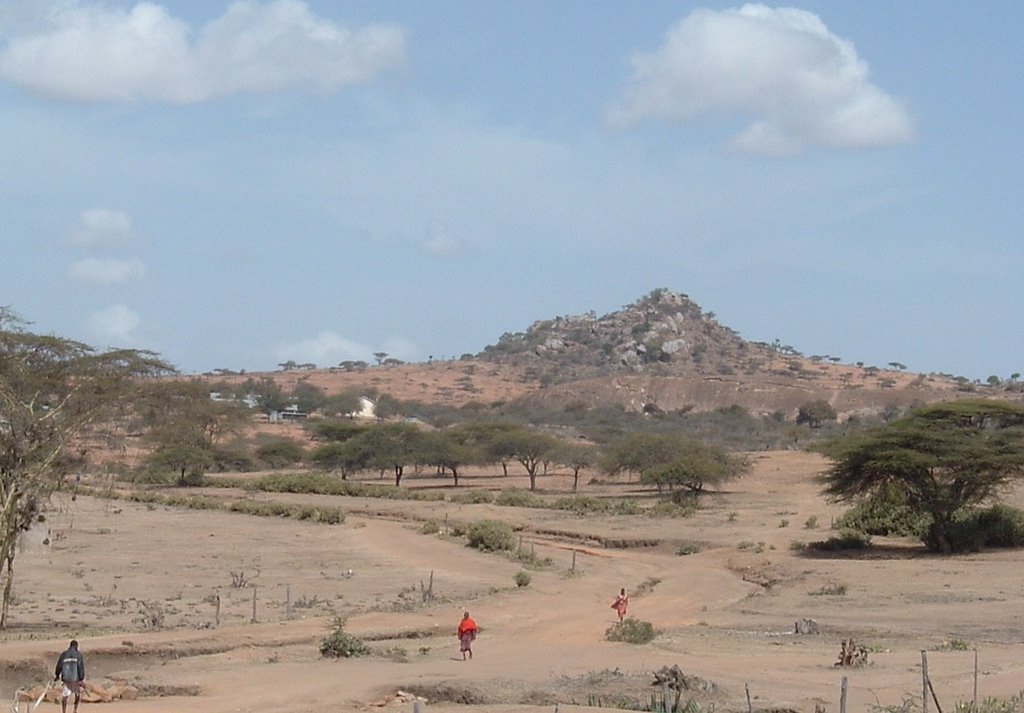
Yet another picturesque landscape shot. I know that after awhile, these all start to look the same, but if you look closely you'll see the rainbow arching across the sky. We're just getting into the rainy season, which is playing hell with the roads (shock-surprise!), but which is providing some beautiful views when 4 o'clock rain showers clear into 5:30 rainbows.


What I was up to over the last ten days was a census of all of the "inkangitie" or homesteads in two of the administrative sublocations in my study area; I'm going to add a third in the next few weeks. An "enkang" (singular) is a circular enclosure containing several usually households; usually several wives of the same man, but occasionally also married sons, brothers, or friends of the head of the enkang. I decided to do the census because it seemed like a lot of political authority in the pastoralist communities I've been studying (mostly Maasai, but also Samburu, Somali, and Turkana) operates at the level of very small groupings of 4-8 inkangitie- essentially small "neighborhoods" within administrative sublocations. That is rather than being organized clearly into large tribes or villages headed by chiefs, the relevant authority seems to be vested in the elders living in a particular "neighborhod". In order to start documenting how governance works at the neighborhood level, I decided to first map out all of the neighborhoods in three sublocations (two which are two different Maasai communities, the Mumonyot and Digiri, and one which is predominantly Samburu). Using GPS readers, my enumerators and I marked the location of each and every Enkang in the first two areas (146 enkang in all) and recorded a range of basic descriptive measures for each homestead including clan, subclan, number of wives, number of children, etc. We also collected questions that were designed to give a snapshot of political leadership in each neighborhood. My intuition from the first set of interviews with the old folks was that there is variation between Maasai and Samburu communities in how neighborhoods are composed and in what rules govern social interactions; this census data should allow me to take a first swing at starting to test this hunch more systematically.


Luckily, this broken down vehicle wasn't mine... in order to try to avoid the transportation mishaps that have defined the first portion of my trip, I sprung for a 6 day rental of a pretty nice land cruiser; it fit my research team comfortably, dealt with the shitty roads admirably, and didn't break down even once. Also it had no sheep inside it, which is always a plus.


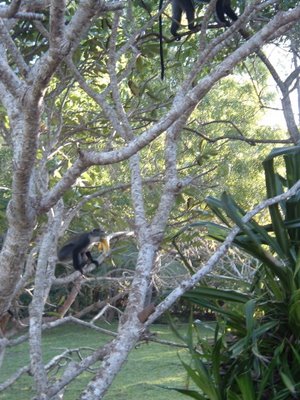
and finally... BABOOOOOOOOOOOOOOOOOOOOOOOOOOONS!!!!!!

stay tuned for complete wedding and circumcision coverage, as well as a special photo feature called "the puppies of Maasailand".

Sunday, April 08, 2007

I'm Gonna Tell it Like a Comeback Story


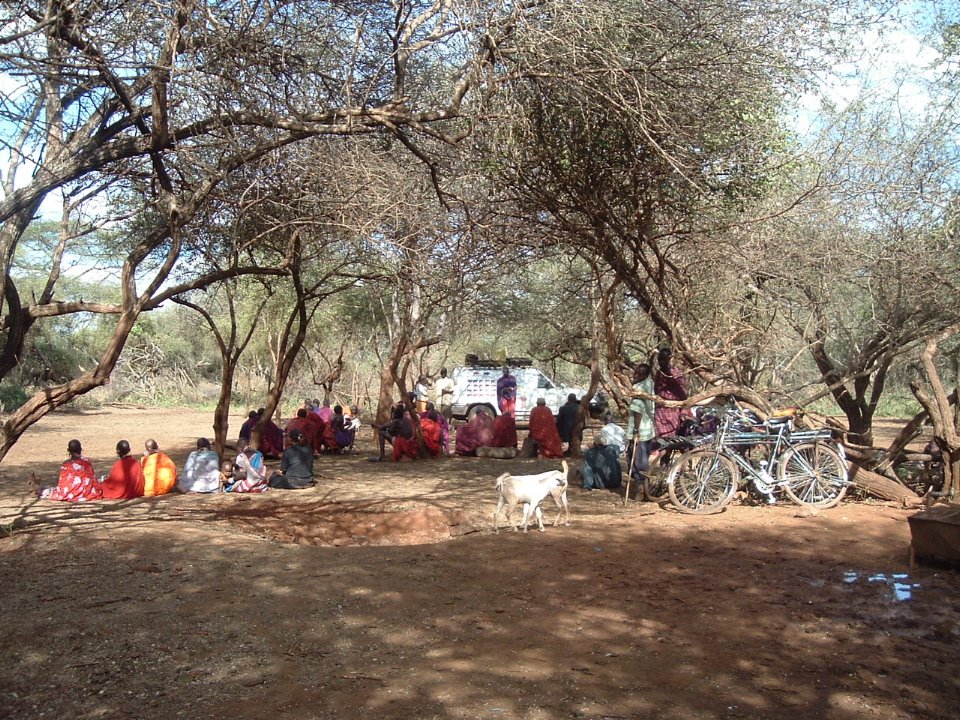
I spent the last 10 days out in the field doing a household census of two administrative sublocations, after which I attended a traditional Maasai wedding and a circumcision ceremony for two teenage boys. There was much singing and dancing, as well as the eating of fried meat soaked in blood. I hope to post more pictures and stories before I head back into the field on Wednesday or so. Until then, I leave you with this:

The other day I met a man called "Kidole Sita", which means "Six Fingers" in Swahili. It is not an ironic nickname.

Friday, March 23, 2007


I love when the Maasai make the news; its never an actual news story, and more like , "Oh those crazy Maasai! What will they do next? They love their cows so much! Silly nomads!" Still, this article is pretty hillarious; at the same time, most of the Maasai guys that I know would not be obsessing about their herds, and would be quite keen to make the most of being so up close and personal with Gisele.

Thanks to Rob Person for sending this along.

Wednesday, March 21, 2007

little miss kenyan sunshine


That is, if you set the movie in northern Kenya instead of the American Southwest and you replaced the beat-up yellow VW bus full of a quirky family of misfits with a yellow beat-up VW bus full of sheep. And this guy right here!


That's right, in my ongoing adventures with transportation, I rode back from doing interviews on Monday in a van full of sheep. We were doing interviews in a town called Ngare Ngiro that is located about 40 minutes west of Nanuyuki, and which was having a big livestock auction that day. This worked out well for the interviews, as there were a lot of pastoralists around. However, by the time we wanted to go home, the only cars going east were also filled with animals. I thought this was fine at first, but then the VW started to break down every 15 minutes or so; in the end we had to get it started in a Litte Miss Sunshine-style running push. In addition, the butt of one of the sheep was pressed up against my leg, and i started to get afraid that it was going to poop on me, so I kept trying to push it away. I was vindicated in my fear when the sheep started peeing on the floor of the van, luckily now further away from my foot.

Tune in Friday, when I cross the red sea in a dinghy with a bunch of somali pirates.

JK! LOL!

Sunday, March 18, 2007

900 cubic centimeters of raw whining power. No outstanding warrants for my arrest.


Oh man, another incredibly busy week. I think I'm going to hold off on writing extensively until I get a chance to resume writing daily journal entries (I'm praying that that will happen soon). In addition, my internet connection seems to be pretty crap-tacular right now, so another photo-heavy update will have to wait (which is a shame, because I have a ton of good ones). Suffice it to say, interviews are going well- so far, I have recorded over 25 hours of oral history from 16 old men and women from various pastoralist communities in the area. I've been working with two enumerators for each interview, one who asks the questions (usually in Maa, occasionally in Kiswahili) and another who translates for me, so that I can follow along and ask follow-up questions if I need to. For the most part, the interviews have gone really well, yielding some fascinating details about the history of the communities I'm studying (which I'll describe in more detail some other time).

Anyhow, I just wanted to share that I rode a motorcycle (a pikipiki for all of you following along kwa kiswahili) for the first time in my life. I suppose "motorcycle" is less accurate than "totally awesome off-road dirtbike driven by a maasai guy named nicholas". I was able to line up an interview with a 104 year old Maasai man in the village of Chumvi, but I wasn't able to rent a car. However, I managed to take a public bus (matatu) to where the paved road ends; from there, my research assistant managed to find a friend with a motorbike who could take me the other 8 kilometers or so back to Chumvi. It was pretty much the most fun thing I've done in the history of ever, and I'm seriously considering buying one and learning to drive it, as it is cheaper than continuously hiring cars, and I find it a lot more pleasant. And don't worry mom, I wore a helmet.


Hi-Diddly-Dee! Goddamn! The Pirate's Life for Me!

More soon! I promise!

Monday, March 12, 2007

On The Road Again


So, as you might be able to tell by the protracted silence, I've been busy. I was in the field from last Wednesday through Saturday night, and am on my way back out right now. In addition, the internets have been quite slow here in Nanyuki, so I've been stymied in my last few attempts to post. At any rate, enjoy these pictures from the weekend, and look for regular posts to resume sometime in the next few days!


Tuesday, March 06, 2007


So as of yesterday, the Suzuki was not yet road-ready; however, it happened that Saaya's uncle Massere was going to be going to be visiting Koija, a group ranch in western Mukogodo and that we could get a ride with him.


On our way to Koija, we stopped briefly in Kimanjo, which is a small town in the Digirri community (one of the five Maa speaking communities of Mukogodo). The village itself was quite small; essentially two rows of small concrete and corrugated metal buildings built across the side of a hill, with houses extending in both directions up and down the hill. Something that I noticed was that most of the people that I saw in the central town were male; pre-teen and early teen boys kicking a soccer ball, older teenagers of the warrior age set standing around with spears and knives, and still older men sitting and talking in front of buildings and under trees; the only women I saw were in transit, carrying large packages from one place to another.


After sitting and chatting a bit, we headed on to Koija, a group ranch in the far western end of Mukogodo division, in the LeUaso community. The idea of the group ranches, which were created in the late 1970s by a joint project of the Government of Kenya and the World Bank, was to formalize a system of communal land tenure, giving entire communities title to the land. The idea was to help “rationalize livestock management” and essentially turn these nomadic pastoralists into market-oriented cattle ranchers. The group ranch project in Koija (unlike in many ranches in southern Maasailand), has succeeded, not necessarily because of improved efficiency of livestock production, but because the community used the group ranch land to create a community-owned eco-lodge in the late 90s. While the group ranch eco-lodges are also common on the other group ranches in Mukogodo, what is more unique about Koija is that it operates in a partnership with a western investor, who actually manages the lodge and does publicity, with the profits after expenses going to the community. The purpose of the trip was that leaders from Tessia, another group ranch on the other side of Mukogodo, are also considering partnering with a western investor, as they currently manage their lodge alone, and they barely break even, and occasionally run losses. The meeting was brokered by Mesere, in his role as a community facilitator for the Laikipia Wildlife Forum.


What I got out of the meeting was that the success of the Koija group ranch was not so much due to the partnership with the western investor as it was its internal structure of the group ranch. What is interesting is that although all group ranches were chartered by the same law, the constitution of the group ranch was up to the individual communities, meaning that it was up to them how to structure the organization. As the Koija group ranch leaders explained it, the unique feature of Koija is the strength of community development groups; small independent organizations created for a specific purpose (women’s beadmaking groups, young men’s singing and dancing groups, etc.). In addition to participating in income generating activities in and around the lodge (selling souvenirs and entertainment to tourists), these organized groups are themselves the constituent units of the Group Ranch Institutional Management committee. As the leaders said themselves, this ensures that information flows from both the level of the group ranch chairperson and board of trustees down to the community, but also in the other direction, providing very good information about the micro-management of the ranch. They also mentioned that these flows of information have also been utilized by the area chief, therefore helping with local government. It will be interesting to see how this organizational structure compares with other group ranches in the area, and how the actual day-to-day operation of Koija matches this description.

Monday, March 05, 2007

In my country, there's a problem...

And that problem is the transport.

As I mentioned in my last post, at the end of last week, I had been pretty eager to get out into the field and start doing interviews; I arrived in Nanyuki on Wednesday and had been in a bit of a holding pattern all day Thursday and Friday, as Saaya had some meetings regarding his HIV/AIDS initiative. At any rate, he and I had sat down on Thursday night and sketched out a relatively ambitious schedule for Friday and Saturday night whereby we would interview 5 or 6 elders from in various neighborhoods in his home community, Il Ngwesi, and then return to Nanyuki sunday so he could have a final meeting about the HIV/AIDS initiative. We arranged to rent a small Suzuki four wheel drive vehicle from his uncle, who works as a community facilitator for the Laikipia wildlife forum. I got a bit nervous when I saw the car, as it looked pretty old and beat up, but he assured me that it drives well.

So around midday on Friday, we set off, eager to get to the village where were going to be doing our first interview. About 15 minutes out of Nanyuki, we started to smell smoke, and when we pulled over, the engine was totally overheating, and it looked like a tube from the radiator to the engine had cracked, meaning that no water was getting to the engine, which is why we were standing at the side of the road looking at a hot, steaming mess. Luckily, while were stopped there trying to figure out what to do,Githeri, a family friend of Saaya's who just happens to work as a mechanic, was coming by on a bus, and he stopped and gave us a hand, changing the tube, and riding with us to the next closest town, where he proceeded to tinker with the engine for the next 2 hours or so- as soon as he fixed one thing, something else seemed to blow.

At any rate, once he got everything fixed and running, we were quite eager to get back on the road. Saaya, Githeri, and I piled into the Suzuki, and we headed off towards our first interview. However, once we got out of range of this village, the roads started to get terrible, until it narrowed to little more than a dusty, uneven path. How bad was it? So bad, in fact that at one point, we skidded off the road and the vehicle TIPPED OVER ONTO ITS SIDE. Everyone was fine, as we were wearing seatbelts, but we were definitely a bit rattled, as was the Suzuki. There were relatively substantial scratches and dents, and the rear view mirror on the driver's side had come off completely. In addition, all of Githeri's intrepid tinkering had apparently been undone, and for the rest of the day, the suzuki stalled out every 20 minutes or so. By the time we got to our first interviewee, it was 6 PM. We decided to just do the interview, and then cut our losses and head back to Nanyuki to have the car looked at by a car repair shop.

The interview went well, but on the way back to Nanyuki, I couldn't help despairing a bit. It sunk in just how tough it is to do research (or anything for that matter) here, and just how bad the transportation infrastructure is. Even though one of my big aims in my dissertation is disproving arguments that state weakness in Africa is solely due to bad roads and other infrastructural problems that make broadcasting power difficult, I am now certain that this is in fact a part of the picture that it is IMPOSSIBLE to ignore.

Saturday, March 03, 2007

Something I’ve been wrestling over in the process of writing my prospectus and preparing to start my project is exactly how to describe the communities I’m working in. My initial inclination to check out Laikipia District as a field site over the summer was reading in several different places that there were Maasai communities there. Upon visiting, these writings seemed to be confirmed; I recognized at least the most superficial aspects of Maasai culture from my prior trips to Maasai communities in the south, and most of the people I talked to self-identified as Maasai. However, things started to get more complicated as I read some papers in the Fall which made strong claims that there were no Maasai in remaining Laikipia, and that all existing Maasai sections were either in southern Kenya or Tanzania. I more or less ignored this discrepancy and carried on, describing this set of communities I intended to work with as “Maasai” in my prospectus. In the last few days, I’ve managed to clarify this situation by reading a bunch of work by Lee Cronk, an anthropologist at Rutgers who did work in Mukogodo division (the area I’m planning on working in) in the 1980s. Cronk clarifies that although most of the people living in Mukogodo division self-identify as Maasai, speak Maa, practice a number of Maasai rituals, and practice cattle pastoralism, they all have in the past practiced some combination of hunting, gathering, or cultivation, all of which fall ouside of the “Maasai Mainstream”. As a result, they are categorized as “Il-Torrobo” by the Maasai, a word that means “hunters” but which carries substantial social stigma.
Cronk’s work focuses on the Mukogodo, who were previously cave-dwelling beekeepers who became cattle pastoralists in about two generations. More interesting to me is a neighboring community, the Mumonyot, who are one of the remnants of the Laikipiak maasai, a peripheral Maasai community that was politically dominant in the early 19th century, but was defeated by an alliance of core maasai sections in the 1860s. After the defeat, some of the Laikipiak were assimilated into the victorious Maasai sections, while others adopted hunting and gathering while trying to regain stock by raiding neighboring communities of Samburu, Boran, and Rendille. Eventually they started herding cattle again, but they are still recognized as being “Dorrobo”. What I think is really fascinating about this community is that it raises important questions about what “survival” of political units entails; even though the Laikipiak were eliminated as a political unit, this didn’t entail death for all (or even most) of the people who had previously identified as Laikipiak. In addition, looking at this community should provide an interesting opportunity to look at the effect of changes in the size, structure, and economic orientation of a community shape and are shaped by local institutions.

truth be told, I wrote this on Tuesday, before I left Nairobi for Nanyuki, the captial of Laikipia. I tried to post it on Thursday, but the power cut out before I got to save (that's how things roll here up in Laikipia), and then I spent the past two days starting my interviews with leaders from two different Mukogodo Maasai communities. Lots of stories from both of those, but not until I'm less exhausted.


LAIKIPIA BABY! I'M LIVING THE DREAM.

Tuesday, February 27, 2007

the logic of pirates in civil war


It looks like my friends the somali pirates are back in full effect, having just hijacked another UN food program ship (although this time after it had already unloaded its cargo).

What's interesting is that this is in fact the first such "piracy incident" in the last 6 months or so- during the brief time that the Union of Islamic Courts was in power, no attacks were reported at all, which is noteworthy because throughout 2005 and early 2006 attacks on commercial shipments, food relief boats, and even cruise liners in the waters off of the Horn of Africa had become commonplace. If this isn't just an isolated incident, and attacks actually pick up again, it will definitely seem that the UIC had been somehow effective in preventing piracy, much as they were reported to have created considerable security in the streets of Mogadishu. At any rate, the way that piracy fluctuates with the patterns of control in the coming months should be an interesting marker of how effective the various parties are at shutting out rival specialists in violence.

Monday, February 26, 2007


One of my biggest anxieties coming into Kenya was yet I hadn't yet obtained a Permit to Conduct research from the government. The biggest problem was that I had been hearing vastly divergent information from different sources. Some researchers I talked to said that I didn't need to bother getting one at all. At the same time, the Government's permit application stated very clearly that an application needed to be submitted by mail two months before research was supposed to begin, and that I would only be able to obtain a visa and enter the country before the permit was granted. As I didn't really have time to submit the application on their timeline (which would have required submitting the application back in October, well before I even knew for certain whether or not I'd be coming back), I decided to gamble and just try to get the permit once I arrived.

A few days ago, I headed down to the Ministry of Science, Education, and Technology with 5 copies of the filled out application sheet, my CV, letters from my advisors at Yale and ILRI, sample interview sheets, my 10 page project description and $300 cash (or more precisely 21,000 Kenyan Shillings). I checked in at the reception desk of the Ministry of Health building, which like many of the government buildings here has this aesthetic that I can describe only "early 70s post-colonial professional"; lots of browns and yellows, flourescent lighting, and mottled floor tiles. I was directed to a room on the 10th floor. From there, I was sent to another office down the hall, and from there to another office on the 9th floor. On arriving at room 923, I found a man seated at a desk; I introduced myself and presented my massive stack of application materials. He said that he had heard that I would be coming because someone from ILRI had called ahead, and said that it looked like everything was in order; the application would be processed immediately and the permit could be picked up the next day. He then asked for the application fee, which he put DIRECTLY INTO HIS POCKET. Seeing me get noticably tense, he said that the cashier's office was closed for the day (it was about 4 PM) and that he would be able to get me a receipt the next day when I came to pick up my permit. At this point I started to freak out again, but was too shell shocked to put up much of a fight; I did get the man to write down his name, office nubmer and cell phone number on a piece of paper. The rest of the night I fretted a bit about whether I was experiencing a bit of that famous "Kenyan Corruption" in action. The next morning around 11 I called the number that he gave me, and the person who answered said "Are you sure you came in yesterday?", which I assured him I did. Not wanting to wait any longer, I caught a bus downtown and headed back into the Education building, expecting the worst.

Fortunately (and as the picture above indicates) this story ends in pure anti-climax. I went into the office, the guy was there, and after a 10 minute wait, he came back with both my permit and receipt. I was stunned and sort of waiting for the catch but there was none; I easily survived my encounter with the much villified Kenyan bureaucracy and was finally ready to start my research.

Friday, February 23, 2007

Somehow I do more reading and finding of secondary sources at the International Livestock Research Institute (ILRI) campus outside of Nairobi than anywhere else in the world (Yale included), and conversely it seems like this reading takes more of my time here than any other activity. I have mixed feelings about this; do I really need to be in Kenya in order to be downloading and reading papers? If I’m doing all of this reading and finding all of these things that I’ve never seen or considered, am I really ready to be in the field, or should I just still be in New Haven doing background reading? An advisor once told a friend that “Data analysis in the capital city doesn’t count as fieldwork”- if that’s the case, then I’m doubly damned, since I ain’t analyzing SHIT in any kind of systematic way.

Maybe this is self-justification/rationalization, but I really do think that it is precisely being here in Kenya, even before heading up to my field site, that is pushing me to discover these sources and lines of research that I otherwise wouldn’t discover working on my own at school. Somehow, when I am in New Haven, it is easy to patch over complexities and make generalizations and believe that everything is working as I assume it is, but as soon as I get here, I start noticing TONS of findings by other researchers that really challenge what I was thinking about on some fundamental levels.

What I’ve been engaged in over the last few days (and what I think is driving this burst of discovery of sources and new arguments) is a process of talking about my project a lot (and preparing to talk about it) with various researchers and colleagues here at ILRI. Talking to people who know the details of the context intimately has forced me to be try to be more specific about what I want to study, why I want to study it, and what I think is going on; when I lack the precise knowledge to do that, I’m pushed to do some searches on Google scholar until I find some pieces that clarify what I was struggling to articulate. I suppose I would have some of this pressure if I had an Africanist to talk to on a regular basis (which I should now that we’ve made a few key Junior faculty hires), but I still don’t think that is any substitute for engaging with researchers who are Kenyans or who have been working in Kenya for over a decade.

Certainly this method of learning from the field is far less glamorous than running around in villages, but so far its been of equal (but distinct) value for me, and I think it is an often overlooked benefit of doing field research.

Wednesday, February 21, 2007

It amazes me how difficult even the most simple tasks are when removed from a familiar/habitual context. For instance, the very basic act of getting home by taxi and getting into my home (which I’ve done HUNDREDS of times over the last 7 years) took me WELL over an hour… and this is from when I was on the street where I am staying. I assumed (incorrectly) that the numbers went up and that all even number addresses would be on one side of the street, and odds on the other. Thus, when looking for 83 Loresho Crescent, I thought I was almost home when I saw 81 and 92. However, the numbers then jumped up to 97 then down to 74 then up to 115. I realized then that I had totally found the address by dumb luck the prior night when I was coming in from the airport, and I wasn’t sure exactly how to find it. What ensued was at least 45 minutes of driving up and down my poorly lit (but gated and therefore safe) street, inquiring about the location of number 83 to every security guard in the neighborhood, none of whom were able to give exact directions (although I did get a good review of the Swahili locatives and words for across from/next to etc.). Eventually, we found a guard who knew the friends I am staying with (“Oh, you stay with Mr. Carlos!”), and he was able to send us practically back to where we had started (of course, why wouldn’t 83 be RIGHT BESIDE 72). Upon getting inside, it took me another 15 minutes to unlock both of the locks (one a kind of tricky padlock and the other an old-school key with key-hole.

I’m up in the air as to how much this difficulty is due to the fact that the new context is a bit “alien” or foreign and how it much it is due to just being somewhere new. What leads me to believe that it is at least somewhat due to the degree of differentness is that I can’t imagine myself having this much trouble if I just picked up and moved to Atlanta, Topeka, or Sheboygan-in any of those cities, I have a good expectation of what kind of lighting, signage and locks I’d encounter and would be able to navigate that very easily, without a lot of effort. However, even subtle and small differences in how houses and neighborhoods are set up here were enough to require IMMENSE amounts of effort and concentration. I imagine that through time, this will become internalized, but until then it seems like even the most mundane details of daily life will be epic quests.

Thursday, August 10, 2006

The Logic of Violence in Interstate War


So if you're not an active student of ORDER! CONFLICT! VIOLENCE! (written like that, it seems like some perverse twist on LIGHTS! CAMERA! ACTION!), you may have skipped over the stellar article on the political side-effects of violence in Lebanon at Salon. Its an excellent illustration of the point that Kalyvas makes in his recent book, The Logic of Violence in Civil War that indiscriminate violence against noncombatants can be extremely politically costly. As the author argues:

"Politically, the bombing has backfired, as the people most likely to support an international campaign to pressure Hezbollah into disarming -- Lebanon's Christian, Sunni and Druze populations -- find themselves under fire from their southern neighbor, and, they say, abandoned by the Western powers they have long tried to emulate. Political analysts in Beirut declare that Hezbollah is positioned to capitalize on the mood shift and entrench itself in Lebanese society."

If this continues to happen-and I think it will without a drastic shift in policy by the Israeli Military-it is possible that Israel may end up propping up and in fact strengthening the organization it is trying to destroy. Whether that is a good or bad thing, I'm not going to try to touch right now. However, I'm getting copies of TLOVICW in the mail to Ehud Olmert and Amir Peretz stat.

Thursday, July 27, 2006

Transatlanticism


That's all for now. More soon- I hope!

Saturday, July 08, 2006

I Had the Title and Titular Line in Out of Africa


So a few observations. Its been like a month or so since I’ve made a “proper post”, in which I provide a short essay combining something I saw with something I’ve read, or hell, even a post where I just say what I did. It has even been like two weeks since I’ve even posted some photos. I guess that has to do with the fact that the more the summer started to confirm with how I expected it would be (traveling around in the field, visiting communities, and meeting organizations), the less I’ve had time to write and reflect. Its an interesting paradox- when I was a bit bored with sitting in an office, I managed to scrutinize and wring every little bit of analytic value out of every single thing I did (not only mundane things such as seeing a mosquito, riding a bus, or eating a meal, but also every small trip I took). However, as I’ve gone on more substantial trips, my writing (and reflecting as a proxy) has fallen off precipitously. While the whole “the more I see, the less I understand” line is a bit trite, it is definitely true that the more data you acquire, the less time you can devote to analyzing any one piece of information.

However, even more shocking than the fact that I haven’t blogged in ages is the fact that I leave in 11 days. This has had two effects on me; one is to force me to slow down a bit and start reflecting on everything I’ve done in the last 3-4 weeks, leading me to sit down and start writing again. The other is to make me realize that there is no way I’m going to be able to do and see everything I want to do and see in the time I have left. On the surface, this would seem to militate against the whole “sitting and reflecting” impulse; however I realized that the best way to waste the time I have left would be to rush around like a maniac, and so decided to spend today doing a little bit of reflecting about what I think I do understand, what I don’t understand, and what/who I would need to see/read/talk to patch up those holes. While this may lead to some incidental blogging, what is more likely is that I’ll continue posting some Africa-inspired essays (and extra photos) after I return, and the blog segues from the straight-up travelblog it never was into the academic/music/news blog I hope it will become.

One thing that I’ve been thinking a lot about is language and communication. As Matt Cushman has observed on several occasions, understanding others who don’t speak your language is certainly possible by carefully observing body language and other non-verbal cues;that is, what poker players call tells. I haven’t picked up on this so strongly, and this might be for a couple of reasons. One might be that “reading people” is the part of poker that I’ve always been the worst at, and there is certainly some truth in that. However, a bigger factor that might be at play is that most of the Kenyans that I’ve encountered are simply using a slightly different “physical vocabulary” from that with which I’m familiar. So therefore, even if I do recognize tells or other gestures, they may not in fact mean what I think they mean. In some ways, I think this can actually lead to greater communication problems and misunderstandings than simple vocabulary deficiencies. Having no idea what someone is saying is annoying but generally avoidable; thinking you know what someone means, when you in fact are way off can lead you quite deeply into considerable confusion.

Similarly, I think even most language-based problems that I’ve encountered are less tied to a complete lack of comprehension, and more due to an inability of me to understand a Kenyan who is speaking English that is grammatically correct, but which uses Swahili idioms and manners of expression. Something that has been extremely in realizing this, and which has gone together nicely with my piece-meal, haphazard acquisition of Kiswahili. For a long time, I found it puzzling that most Kenyans to whom I said “Hi” replied “Fine”, until I learned that the greeting “Jambo!” idiomatically means “How are you?”, to which the response “Mzuri” means fine. However, because Jambo is usually literally translated as just “Hi”, the odd mismatch I noted above occurs frequently.
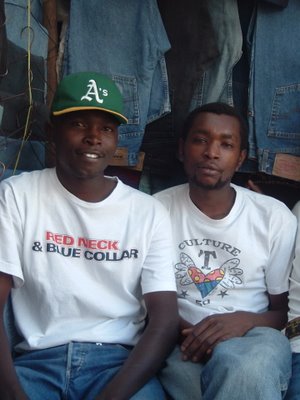


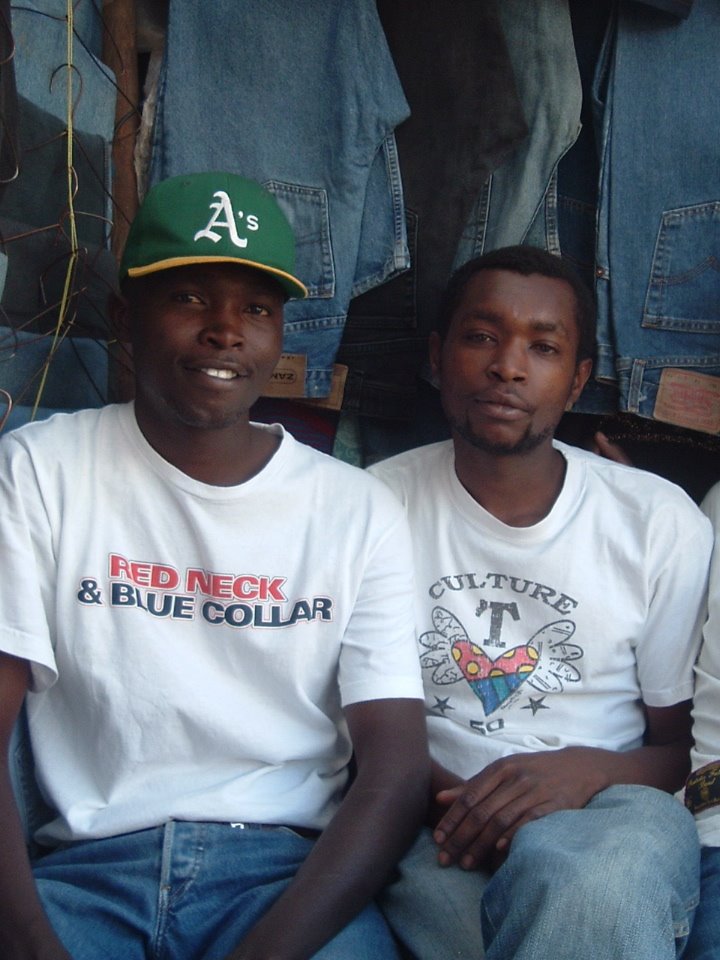
This all leads me back to dead horse that I’ve continued to beat throughout this trip… culture and context matter immensely. For instance, when I was just up in Nanyuki, a small town on the equator that overlooks Mount Kenya, I spent some time hanging out with some guys who run a small second-hand clothes kiosk. I struck up a conversation with them when I noticed that one of the guys, Steve, was wearing a shirt that said “Red Neck. Blue Collar.” When I explained to him what a “redneck” was, he was quite amused- however my efforts to persuade him to grow a mullet were in vein. Along similar lines, Steve and his buddy Peter helped me satisfy my own cultural-irony-seeking urges by helping me obtain my very own “Ngombe” hat. Ngombe means “cow” in Kiswahili (quite appropriate, given my work with cattle herders), and is also the name of a barbed wire company who made these hats and gave them out to farmers. Thus, as I walk around Nairobi, I certainly hope I’ll be able to give numerous Kenyans the enjoyment that I received from seeing a Kenyan wearing a shirt that identified him with the NASCAR watching/Bush-Voting demographic.


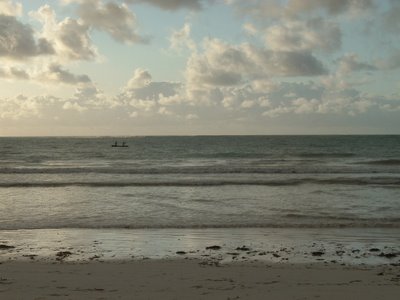
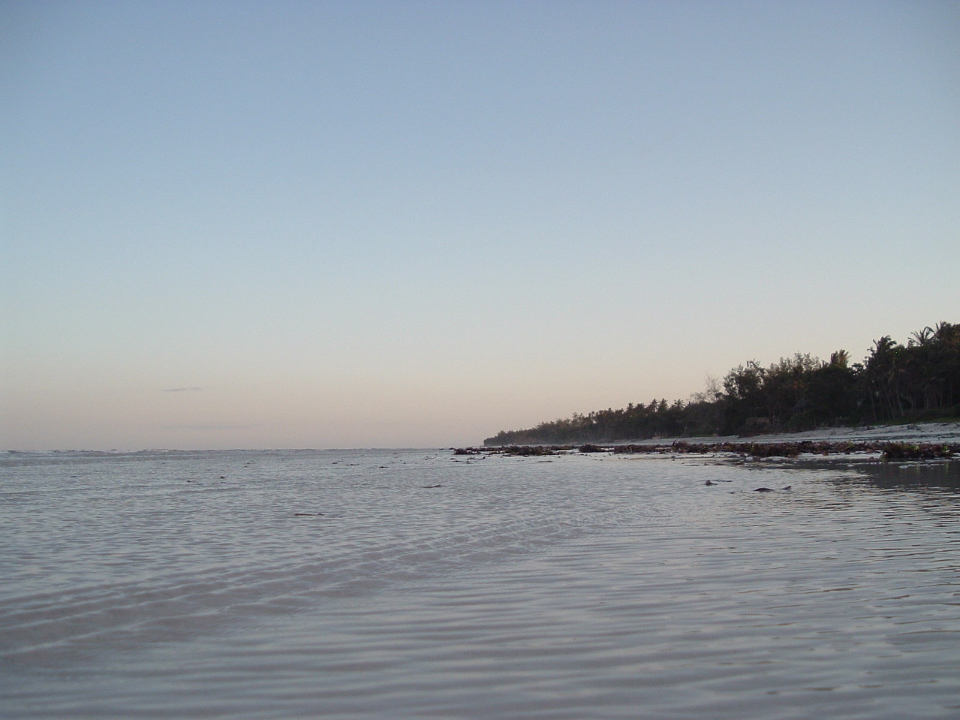
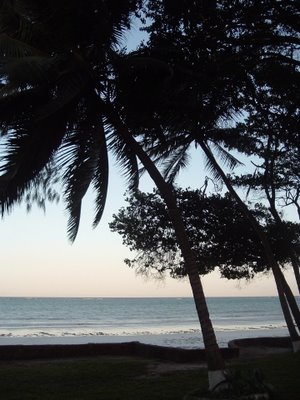
Oh, and also… beach happens.
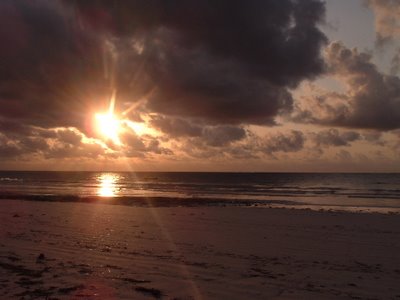


Monday, June 26, 2006

A Moveable Beast

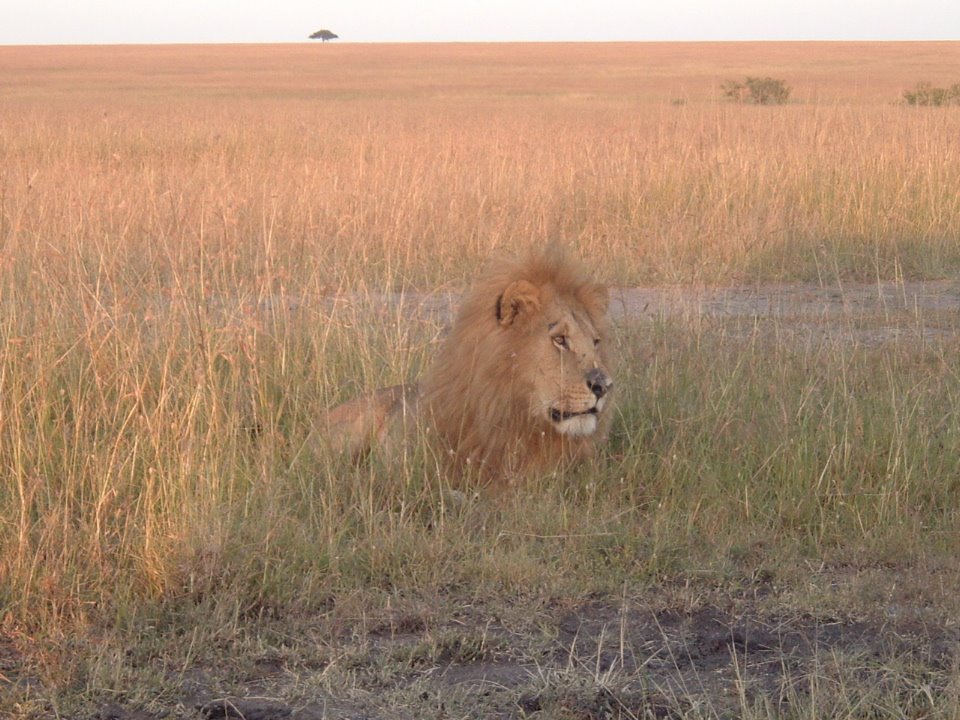
So I have a confession to make, dear reader. I haven't been fully open and honest with you. I led you to believe that I had posted the best of my game drive pictures from Maasai Mara. In reality, I've held out on you... the following series of pictures is undeniably the most badass of any that I've taken on this whole trip. I'm not even lion to you. HAHAHAHAHAHAHAHAHA.


This was almost right at the beginning of our game drive. My friend Dickson knew a spot where the lions typically chill early in the morning. Sure enough, he was chilling about 15 yards from the road, allowing us to pull up right beside him. He didn't seem to be too bothered by our presence, but as more and more safari vehicles started to swarm around him like flies on dog turds, he got a little annoyed, and let out a mighty roar, which I was lucky enough capture in the above sequence of images. Yet they hardly do the event justice. Hemingway aptly describes this sensation in True at First Light, which I've been reading throughout my trip, writing: "You cannot describe a wild lion's roar. You can only say that you listened and the lion roared. It is not at all like the nose the lion makes at the start of Metro Goldwyn Mayer pictures. When you hear it you first feel it in your scrotum and it runs all the way up through your body." Suffice to say, I identify with the first 2/3s of this quote much more than the last 1/3, but at the same time, unlike Hemingway apparently, I am not in the habit of puting my junk in the general vicinty of lions' mouths.
Saturday, June 24, 2006

I Want Your Skull. I Need Your Skull.


...And another week goes by. As you can probably tell by the fact that I've completely fallen off of the face of the blogosphere (yeah that's right you can fall off of something which has no spatial referent...hot damn!) in the past week, I was in the field again. This time, I went with David to some group ranches in Southern Kajiado district, which like Kitengela and Narok are Maasai Communities which border a wildlife park. In this case the park in question is Amboseli national park, which is a bit smaller than either Maasai Mara or Nairobi National Park, and which is notable for having a TON (or if you really want to nitpick MANY TONS) of elephants and a spectacular view of Mt. Kilimanjaro (Amboseli, like Maasai Mara is right on the Kenya-Tanzania border). However, when I was there, I wasn't able to get a good shot of Kili (as the locals call it) and we didn't get into Amboseli proper. The main thing we did while we were there was go to several community meetings that Shauna BurnSilver, another ILRI affiliated PhD student was holding in the area. Shauna is in the process of completing a dissertation in the field of Human Ecology on mobility and diversification among Maasai pastoralists in several group ranches in Kajiado district. In a follow-up visit last year, Shauna held a number of focus groups in her study communities, on the topic of the major development issues facing these communities; the leading issues that group participants brought to light were the breeding of drought-resistant cattle, the subdivision of group ranches, and diversification of Maasai livelihoods away from pure pastoralism. The purpose of the community meetings to address these issues, using the findings of Shauna's research (and other work by ILRI researchers in the fields of vetrinary sciences, ecology, and economics) in order to help inform household and community-level decision-making processes. I'll probably talk at more length later about why this is an interesting cool model for doing research, but suffice to say that it was another compelling example of how to do work that is both theoretically compelling and meaningful to the community that is the subject of the research.
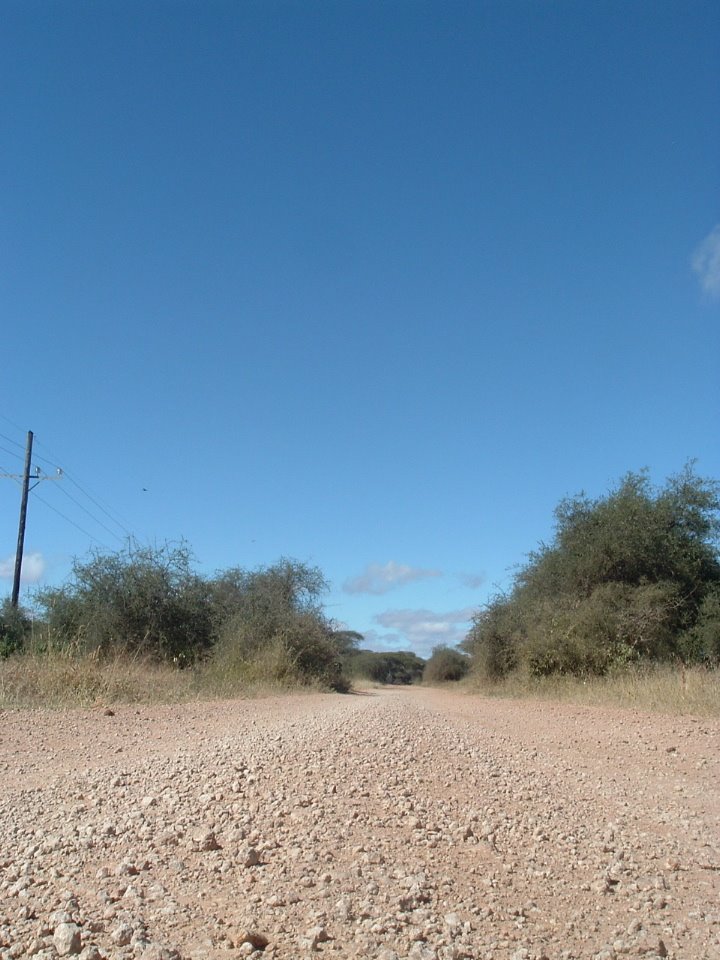
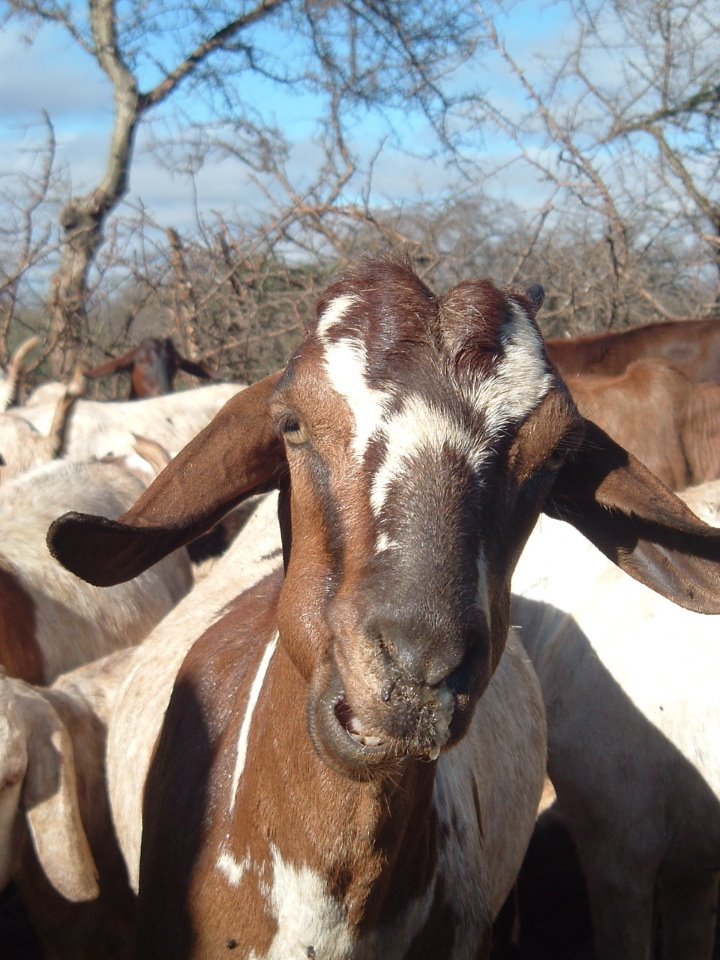
But that is another post for another today. In spite of the lack of touristy pursuits on this trip, I was able to take lots of photos, which I leave you with now. Look for a bunch more actual, real posts this week.